 How-to
How to Store ATV Tires Long Term Outdoors Without Damage
Last Updated: November 22, 2026
Quick Summary
To store ATV tires long term outdoors, clean and dry them fully, set the manufacturer's storage pressure, then raise them off the ground. Stand them upright on a level surface and cover them with a breathable cover that blocks rain and sun. Check them every few months for cracks, bulges, or mold.
- Tires can be stored outdoors long term only if protected from sun, water, and ground contact.
- Dry tires completely before covering them, since trapped moisture causes mold and rot.
- Set tire pressure to the manufacturer's storage level, not zero unless it is stated as safe.
- Store tires upright whenever space allows, and keep stacks to three or four tires if stacking flat.
- Check stored tires every few months for cracks, bulges, soft spots, and mold.
Table of Contents
- Why Outdoor Storage Damages ATV Tires Over Time
- How Long Can Tires Be Stored Outside?
- Step-by-Step: Preparing and Storing Loose ATV Tires Outdoors
- Should Tires Be Stored Vertically or Horizontally?
- How to Protect Tires From Sun Damage and Moisture
- Outdoor Tire Storage Ideas for Different Setups
- Inspecting Stored Tires and Choosing a Secure Storage Yard
- Frequently Asked Questions
Why Outdoor Storage Damages ATV Tires Over Time
Tires left out in the open for months often come back cracked, dry, or flat-spotted. Storing tires outdoors is not automatically a mistake, but it does expose rubber to sunlight, rain, temperature swings, and standing moisture.
UV rays from direct sun break down the rubber compounds over time.
The damage is gradual, which is why many owners miss it. A tire can look fine on the outside while the sidewall has already started to crack.
How Long Can Tires Be Stored Outside?
Tires can be stored outdoors for a long period only if they are protected from sun, water, and ground contact. Without that protection, the rubber starts to degrade much sooner.
The safe storage window depends on your climate, how well the tires are covered, and how often you check them. Shaded, covered, and raised tires hold up far better than tires lying uncovered on wet gravel.
- Shaded and covered: the longest safe window, with regular checks
- Partly exposed: a shorter window, and tires should be inspected more often
- Uncovered and on the ground: the shortest window, and damage can start within a season
Step-by-Step: Preparing and Storing Loose ATV Tires Outdoors
Good preparation matters more than the storage spot. Follow these steps before the tires go outside.
- Remove the tires from the rims if possible.
- Clean off mud, dirt, and debris.
- Let the tires dry completely.
- Set the tire pressure to the level recommended for storage.
- Inspect the tread and sidewalls for cuts, cracks, or bulges.
- Position the tires off the ground and cover them.
- Write the storage date on a tag and set a reminder for your next check.
Cleaning and drying before storage
Wash the tires with mild soap and water, then rinse off all the soap. Soap residue left on rubber can attract dirt and speed up wear.
Dry the tires fully before you cover them. Trapped moisture is one of the main causes of mold and rot during outdoor storage.
Setting tire pressure for storage
Set the pressure to the level recommended by the tire manufacturer for storage. Check the sidewall marking or the owner's manual for the exact number.
Do not store tires at zero pressure unless the manufacturer says it is safe. Low pressure can make the tire bead and sidewall more prone to deformation.
The steps below summarise the preparation process before tires go outside.
| Step | What to do | Time or frequency |
|---|---|---|
| Remove tires from rims | Take them off if possible | Before storage |
| Clean debris | Wash with mild soap and water, rinse soap off | Before storage |
| Dry completely | Let tires dry before covering | Before covering |
| Set pressure | Use the manufacturer's storage level | Before storage |
| Inspect | Check tread and sidewalls for cuts, cracks, bulges | Before storage |
| Position and cover | Raise off the ground and cover | Before storage |
| Tag and remind | Write storage date and set a check reminder | Next check |
Should Tires Be Stored Vertically or Horizontally?
The short answer: store ATV tires upright whenever the space allows, and treat horizontal stacking as a short-term compromise rather than a long-term plan. The reason is mechanical. A tire standing on its tread carries load through the circumference of the carcass, which is the shape it was engineered to hold. A tire lying flat puts sustained point load on one section of the sidewall and tread, and rubber that stays compressed for months, especially through freeze-thaw cycles, takes a set and develops flat spots that may not fully relax after you mount and inflate it.
Upright storage: the default for long-term outdoor storage
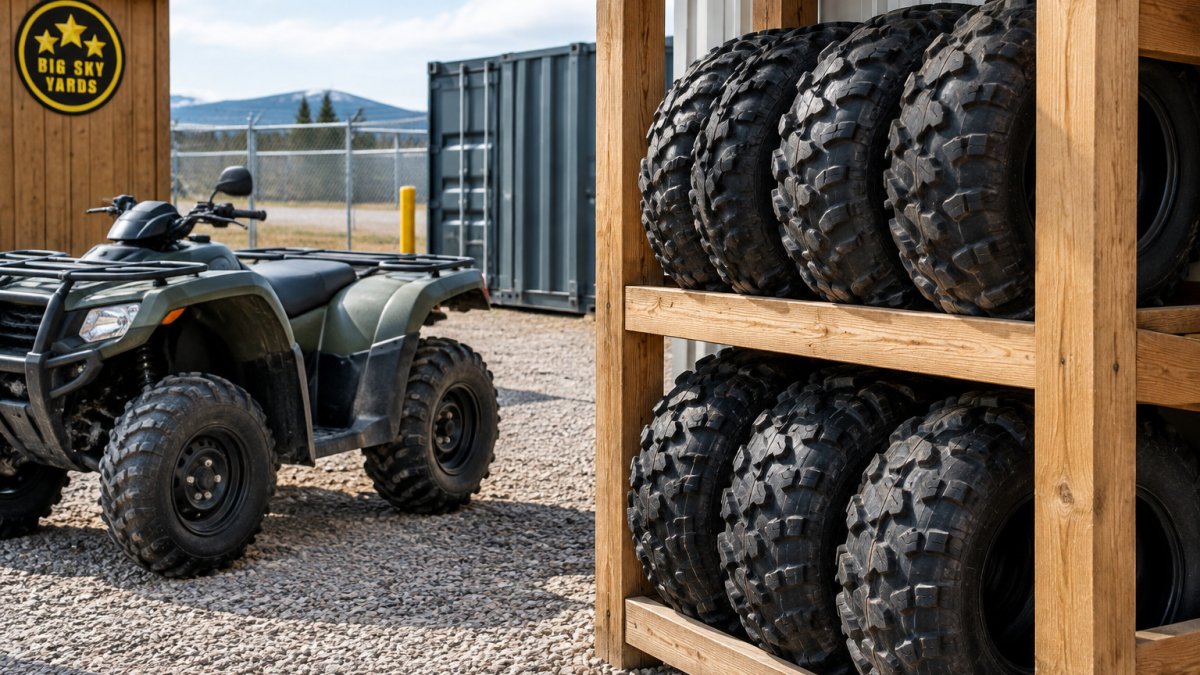
Stand each tire on its tread on a raised, level surface such as a pallet or a rack with slats.
Watch out: a tire standing upright on soft ground, gravel, or bare soil can sink and lean, which puts a constant side load on the sidewall. Set upright tires on a hard, level surface or on a pallet that will not shift.
Horizontal stacking: limits and rotation
Stacking flat is acceptable for short-term storage or when floor space is tight, but keep the stack short, most practitioners treat three to four tires as a practical ceiling for long-term outdoor storage, and fewer if the tires are large or the weather is hot. Stack tires squarely so the weight is distributed around the tread rather than pinching one sidewall. Put a board or pallet underneath so the bottom tire is not sitting in groundwater, and put a breathable cover over the whole stack rather than wrapping each tire.
Rotate a stack on a schedule. Every few weeks, restack the tires in a different order and flip the bottom tire to the top so no single section of rubber stays compressed for the whole storage period. If you cannot commit to rotating, upright storage is the safer choice.
What about hanging or suspending tires?
Hanging tires from a rack or wall is common for mounted wheels and keeps them off the ground, but it introduces its own risk: a tire hung by a single point can distort around the contact area. If you hang tires, use a wide sling or a rack that supports the tread across a broad span, and avoid hanging loose tires by the bead. Hanging is best treated as a space-saving option for rims and wheels, not as the default for bare tires.
A quick decision rule
- Long-term outdoor storage, space available: upright on a raised, level surface, spaced apart, covered.
- Long-term outdoor storage, tight space: short stack (three to four tires), rotated every few weeks, on a pallet, covered.
- Mounted wheels: upright or hung from a wide support; avoid long-term flat stacking.
- Loose tires with no rims: upright is strongly preferred so the bead area can drain and dry.
How to Protect Tires From Sun Damage and Moisture
Sun and moisture are the two forces that do the most outdoor damage, and they pull in opposite directions: the more completely you seal a tire against rain, the more effectively you trap the moisture that condenses underneath. The goal is not a waterproof cocoon. It is a cover that sheds rain while letting water vapor escape, paired with a base that keeps groundwater away from the rubber.
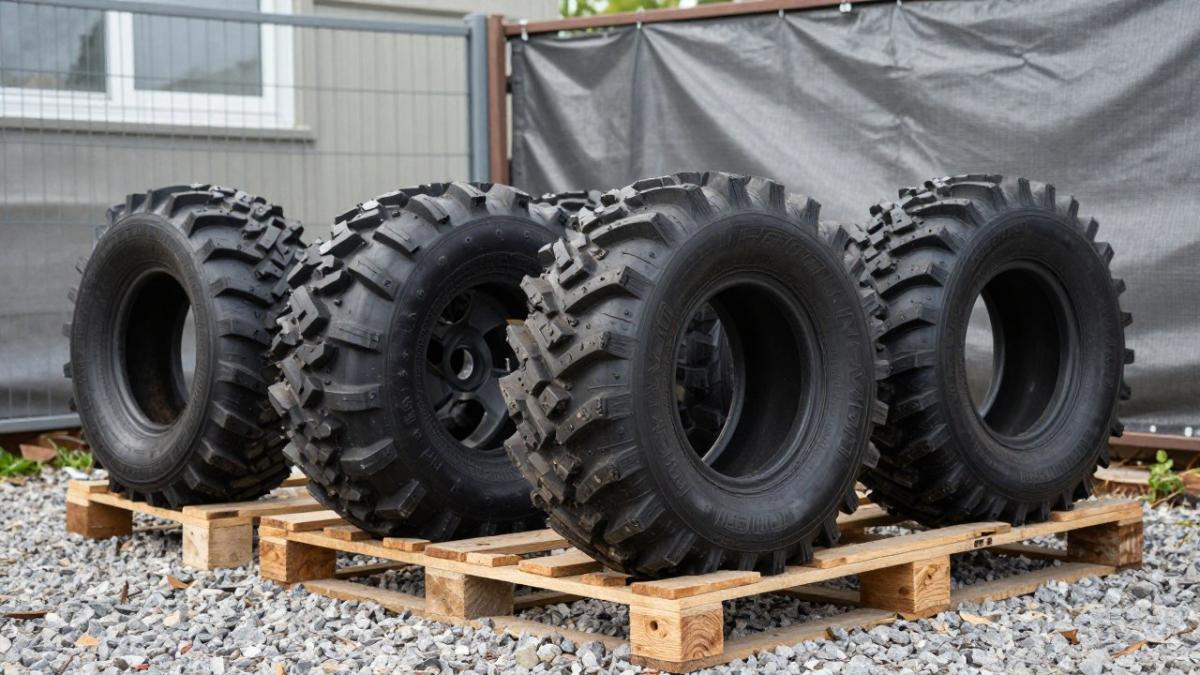
Why a sealed cover backfires
A tire stored outdoors goes through daily temperature swings. Warm air inside a tightly wrapped tarp or plastic bag holds moisture; when the temperature drops overnight, that moisture condenses on the coolest surface, the tire and the inside of the cover. A sealed cover therefore can keep rain off while steadily wetting the tire from the inside.
Watch out: a dark plastic tarp pulled tight over tires can also trap heat on sunny days, and repeated heat-and-moisture cycling is harder on rubber than shade and airflow.
Choosing a cover that breathes
Look for a cover made of a breathable, water-resistant fabric rather than a nonporous sheet. The fabric should block direct rain but let air pass. Drape the cover so it sheds water away from the tires and leaves a gap at the bottom for air to enter and exit. Do not cinch the cover tight to the ground, a small opening at the base is what allows the condensation cycle to break.
Managing condensation under the cover
Even a breathable cover benefits from a few habits:
- Keep the tires off bare ground and out of low spots where water pools. A pallet or rack with airflow underneath is the single most effective moisture control.
- On dry, sunny days, lift the cover for a few hours to let the tires and the underside of the cover dry out. A monthly airing is a common pattern.
- Avoid storing tires directly against a wall, fence, or each other with no gap; trapped air between surfaces stays humid longer.
- Do not cover tires while they are still wet from washing or rain. Dry them first, then cover.
Adjusting the approach to your climate
The right balance shifts with local conditions, and a single set of rules does not fit every yard:
- Intense sun and heat: prioritize shade and UV-blocking cover fabric. Heat accelerates rubber degradation, so a covered rack under a roof or shade structure outperforms a cover alone.
- Heavy rain and humidity: prioritize drainage and airflow. Raise tires well off the ground, keep them out of puddles, and favor a cover with a vented top or open base over a sealed one.
- Freezing temperatures and freeze-thaw cycles: prioritize keeping tires dry and off the ground so meltwater does not refreeze around the rubber. Freeze-thaw stress compounds flat-spotting, so pair moisture control with upright storage.
- Dusty, windy areas: a breathable cover also keeps grit out of the bead area, but check that wind is not whipping the cover against the sidewalls, which can scuff rubber over months.
A simple moisture check
When you inspect stored tires, run a hand under the cover and along the sidewall. Damp fabric, a musty smell, or beads of water on the inside of the cover mean the setup is trapping moisture and needs more airflow, a higher pallet, a looser drape, or a more breathable cover. Catching that early is far cheaper than replacing a tire whose sidewall has already started to degrade.
Outdoor Tire Storage Ideas for Different Setups
The right setup depends on the space you have. Here are a few common options.
- Backyard corner: Stand tires upright on pallets against a fence, with a breathable cover.
- Storage yard: Place tires on raised racks inside a secured, fenced area with good drainage.
- Shed or carport: Keep tires off the floor and away from doors where rain can blow in.
Each option works best when the tires are raised, covered, and checked regularly.
Inspecting Stored Tires and Choosing a Secure Storage Yard
Check stored tires every few months. Look for cracks, bulges, soft spots, and mold.
When choosing outdoor space, look for a fenced yard with a locking gate, good lighting, and security cameras.
Our yards are located near major crossroads and highways, including easy access to I-86, so you can check on your tires without a long drive.
Ready to keep your ATV tires secure while you're off the trail? Big Sky Self Storage Yards offers fenced, gated outdoor storage with onsite lighting and security cameras.
Frequently Asked Questions
How long can tires be stored outside?
Tires can be stored outside for extended periods, but UV exposure, temperature swings, and moisture shorten their life. Keep them covered or shaded, raised off the ground, and inspected at least every few months. Tires stored indoors in a dry, cool place generally last longer than those left exposed. Check each tire for cracking, bulges, and flat spots before reinstalling it, and replace any tire showing structural damage.
Should ATV tires be inflated during long-term storage?
Most owners keep stored ATV tires at a moderate pressure, close to the manufacturer's recommended level, to help the bead and sidewalls hold their shape. Overinflating a tire during storage can stress the casing, while severe underinflation can encourage flat spots. Check pressure periodically, since tires lose air slowly over months, and adjust before you mount them again.
Can sunlight and moisture damage ATV tires?
Yes. Prolonged UV exposure dries out rubber and promotes surface cracking, while trapped moisture can encourage mold, mildew, and rot on tire surfaces. Store tires out of direct sun, use a breathable cover that allows airflow, and keep them off wet ground. Wiping tires dry before storage reduces the risk of moisture-related deterioration.
How often should stored ATV tires be inspected?
Inspect stored tires every one to three months, depending on your climate and how long they will sit. Look for cracks in the sidewalls, bulges, dry rot, signs of pests, and standing water under covers. Rotate the tires slightly if they rest on the ground, and recheck pressure at each inspection. Early checks let you catch problems before they become unusable.