 Ultimate guide
Best RV Parking Space Dimensions: Size Guide
Table of Contents
- RV Parking Space Dimensions: The Complete Size Chart
- RV Parking Space Size by RV Type
- RV Parking Space Width and Length: Standard vs. Oversized Sites
- RV Parking Space With Slide-Outs: Calculating Total Footprint
- RV Parking Maneuvering Clearance: Aisle Widths and Turn Radius
- Storage Facility vs. Campground: How Site Layout Changes Dimensions
- Frequently Asked Questions
Last Updated: October 12, 2026
RV Parking Space Dimensions: The Complete Size Chart
The best RV parking space dimensions start at 12 feet wide by 40 feet long for a full-size Class A motorhome, but the right number depends entirely on your rig and what you plan to do with it. This guide breaks down the best RV parking space dimensions by vehicle type, shows you how to measure your own rig, and explains why storage lots and campgrounds size their sites so differently.
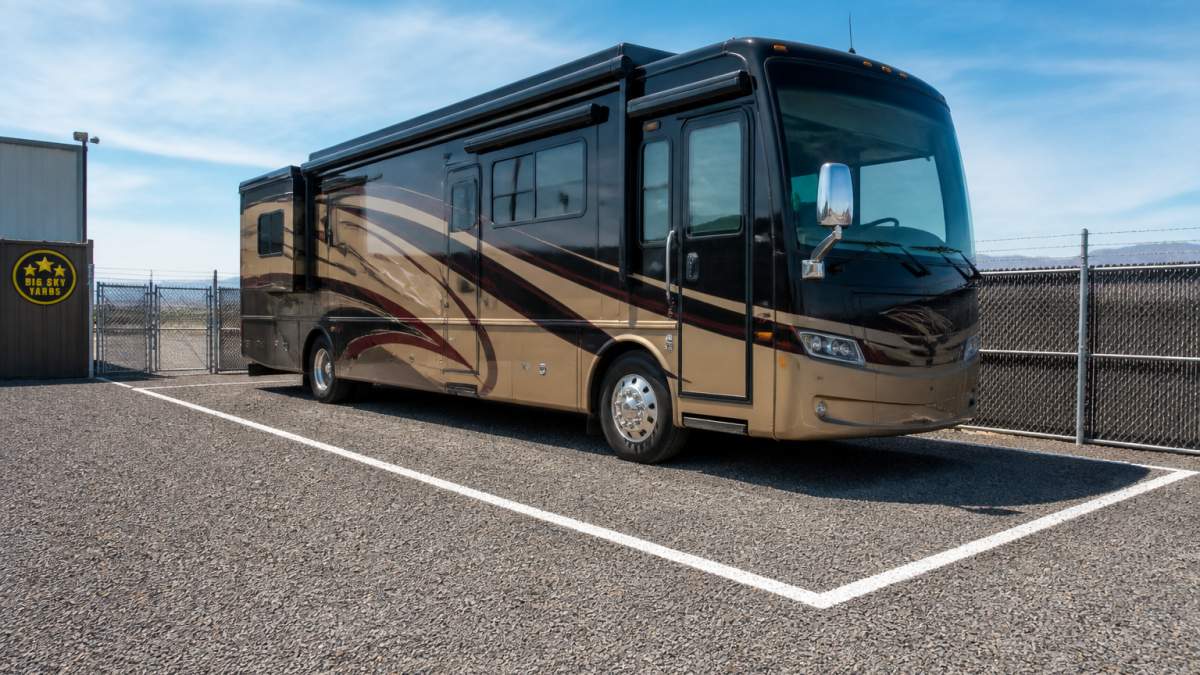
RV parking space dimensions are the minimum width, length, and clearance measurements required to safely store or park a recreational vehicle without blocking access, damaging the rig, or violating site rules. A common mistake is treating length as the only number that matters. Width and vertical clearance decide whether you can open a slide-out, walk around the unit, and pull out cleanly on a rainy morning.
How to Measure Your Rig Before You Reserve a Space
Measure your RV at its widest and longest points, not the spec sheet numbers. Ladders, mirrors, spare tires, and rear-mounted racks add length that manufacturers don't always list.
Here's the method we recommend:
- Park on level ground and extend every slide-out.
- Measure bumper to bumper, including any hitch or ladder.
- Measure wall to wall with slides out, not slides in.
- Measure total height to the top of the AC unit.
- Add the length of your tow vehicle if you're parking a trailer or fifth-wheel.
Write all four numbers down and carry them with you. A storage facility or campground can only match you to the right spot if you give them the real footprint, not the brochure figure.
RV Parking Space Size by RV Type
Sizing falls into three rough buckets: compact trailers and campervans, mid-size motorhomes and travel trailers, and large rigs that need oversized sites. The table below gives practical ranges, not exact specs, because two 30-foot trailers can measure very differently once slides and hitches are counted.
| RV Type | Typical Body Length | Recommended Space Width | Recommended Space Length |
|---|---|---|---|
| Class B campervan | 18-22 ft | 10-12 ft | 24-26 ft |
| Class C motorhome | 24-30 ft | 12 ft | 32-36 ft |
| Class A motorhome | 30-40 ft | 12-14 ft | 40-45 ft |
| Travel trailer | 18-30 ft | 12 ft | 30-36 ft |
| Fifth-wheel | 28-40 ft | 12-14 ft | 40-45 ft |
| Toy hauler | 25-40 ft | 12-14 ft | 40-48 ft |
Class A Motorhome Dimensions
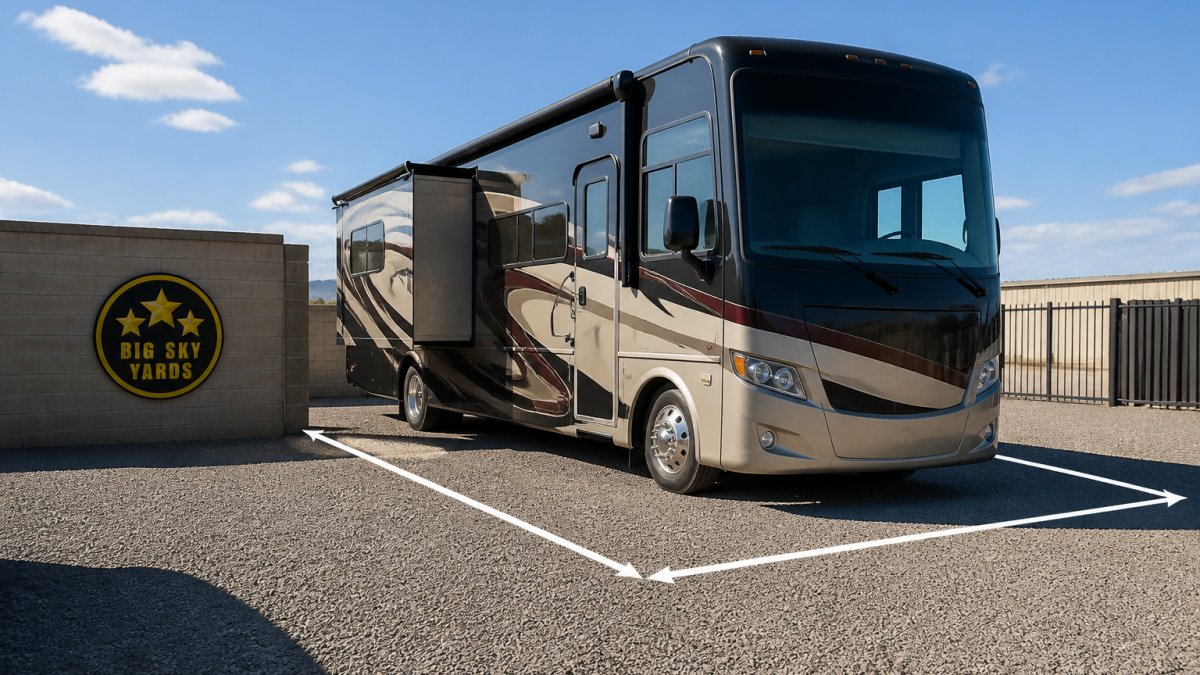
Class A motorhomes are the widest common rig on the road, often pushing the full legal road width before mirrors. Plan on a 12-foot-wide space at minimum, and step up to 14 feet if you want to extend slide-outs and still walk around the coach.
Length is where owners get caught. A 40-foot coach with a rear ladder and a front hitch can measure 42 feet or more. A 12 x 40 spot fits many XL motorhomes, but if your coach runs long, confirm the exact usable length before you commit.
Fifth-Wheel and Travel Trailer Dimensions
Towable rigs add a wrinkle: the tow vehicle. A 35-foot fifth-wheel plus a crew-cab pickup can occupy 55 feet of combined length. If the site only counts the trailer, you'll be backing the truck into the drive aisle every time you visit.
For travel trailers, the tongue adds 3 to 4 feet beyond the box. A trailer listed at 28 feet can measure 32 feet from coupler to rear bumper. Always size to the total, not the box.
RV Parking Space Width and Length: Standard vs. Oversized Sites
Standard sites typically run 10 to 12 feet wide and 30 to 40 feet long, while oversized sites push to 14 feet wide and 45 feet or longer to handle large rigs and slide-outs. The width difference is what separates a site you can use from one you merely fit into.
Width matters more than most owners expect. A 10-foot-wide space leaves roughly a foot of clearance on each side of a wide-body coach, which is fine for storage but miserable if you need to load gear, check tires, or run a generator. Oversized sites trade acreage for usability.
Length is more forgiving, but only if the site accounts for overhang. Some pads are measured to the curb, and a rear overhang can hang past the line into the drive aisle.
RV Parking Space With Slide-Outs: Calculating Total Footprint
Add the depth of every extended slide-out to your width, then add a walking margin. That is the short version. The longer version is where most owners undersize their space, because slide depth varies by RV class and the projections that matter are not just the slides.
Here is how slide depth typically breaks down by rig type:
| RV Type | Typical Slide Depth (each) | Number of Slides | Added Width With Slides Out |
|---|---|---|---|
| Class B campervan | 2-3 ft (often none) | 0-1 | 0-3 ft |
| Class C motorhome | 2-3 ft | 1-2 | 2-6 ft |
| Class A motorhome | 3-4 ft | 2-3 | 6-12 ft |
| Travel trailer | 2-3 ft | 1-2 | 2-6 ft |
| Fifth-wheel | 3-4 ft | 2-3 | 6-12 ft |
| Toy hauler | 3-4 ft (plus ramp) | 1-2 | 3-8 ft |
A single slide-out can extend 3 feet or more from the wall, and opposing slides on a wide-body coach can add 6 to 12 feet to the total footprint. That is the difference between an 8.5-foot-wide coach and a 20-foot-wide occupied footprint once both slides are out.
But slides are not the only projection. Before you finalize a number, add these:
- Awning: 8 to 12 feet of horizontal projection when fully extended, and it needs clear ground beneath it.
- Entry steps: 2 to 3 feet out from the door, plus room for a person to stand.
- Rear ladder, spare tire, or bike rack: 1 to 3 feet beyond the rear bumper.
- Front hitch or tow bar: 2 to 4 feet beyond the front bumper on a motorhome with a toad.
- Tow vehicle: full length of the truck or SUV if you are storing a trailer or fifth-wheel.
Here is a worked example. A 40-foot Class A with two opposing slides, a 10-foot awning, and a tow bar measures roughly 8.5 feet wide with slides in. With both slides out, it occupies about 16.5 feet of width.
That is why the number that decides whether a space works is total footprint with slides out, not body length. Size to that figure and you will never fight your own rig for room.
RV Parking Maneuvering Clearance: Aisle Widths and Turn Radius
Drive aisles need 20 to 30 feet of width for comfortable backing and turning, and tight lots with narrow aisles are the single biggest source of damaged rigs. A back-in site is only as good as the aisle in front of it.
Backing a 40-foot coach into a site requires room to swing the nose. If the drive aisle is 15 feet wide, you'll be making multiple corrections and risking your mirrors.
Turning radius matters for the approach, not just the site. A large rig needs a wide, sweeping turn to line up with a back-in pad. If the access road is narrow or lined with parked units, even a skilled driver will struggle.
For storage lots, the trade-off is different. You're not backing in every weekend, so a tighter aisle is acceptable if you can still get in and out safely. For an RV park where you'll maneuver regularly, pay for the wider aisle.
Federal Highway Administration guidance on commercial vehicle turning and clearance offers useful background on how much room large vehicles need to turn and back safely.
Storage Facility vs. Campground: How Site Layout Changes Dimensions
Storage facilities prioritize density, while campgrounds prioritize livability. That difference shows up directly in the numbers, and the numbers are what determine whether your rig actually fits.
A storage facility packs sites closer together because owners only visit occasionally. A typical outdoor storage pad runs 10 to 12 feet wide and 30 to 40 feet long, with a shared drive aisle of roughly 20 to 25 feet.
A campground sizes sites for daily use.
The layout math matters because it drives what you can do on the site. A storage pad is sized for the rig alone.
| Factor | Storage Facility | Campground |
|---|---|---|
| Primary goal | Density and security | Comfort and livability |
| Typical pad width | 10-12 ft | 12-14 ft (14-16 ft oversized) |
| Typical pad length | 30-40 ft | 40-45 ft (60-75 ft pull-through) |
| Drive aisle width | 20-25 ft | 24-30 ft |
| Sites per acre | 25-40 | 12-20 |
| Slide-out room | Limited | Generous |
| Tow vehicle parking | Often separate | Usually on-site |
| Access frequency | Occasional | Daily |
One factor that catches owners off guard is emergency access. Fire codes and RV park standards generally require interior roads wide enough for a fire apparatus to reach any site, and that requirement is one reason campground aisles are wider than storage-lot aisles.
National Fire Protection Association standards for RV park site spacing and access outlines how site layout affects emergency access, which is worth understanding before you assume any open patch of pavement will do.
If you're storing long-term, a storage facility's tighter layout is usually fine, and the lower cost per square foot reflects that.
Frequently Asked Questions
What are the typical dimensions of an RV parking space?
Standard RV parking spaces are generally 10 to 12 feet wide and 30 to 40 feet long. For a Class A motorhome, a space measuring 12 feet by 40 feet is common to accommodate the vehicle and provide a small buffer. Oversized sites may be 14 feet wide and 45 feet long or more, which helps with slide-outs and easier maneuvering.
How wide should an RV parking space be?
An RV parking space should be at least 10 feet wide for smaller travel trailers, but 12 feet is a safer minimum for most motorhomes. If you have slide-outs, you need an additional 2 to 3 feet of width on the side where they extend. A 14-foot-wide space gives you comfortable room to open slides and walk around the vehicle without obstruction.
Do RV parking space dimensions include room for slide-outs?
Most standard dimensions do not automatically include room for slide-outs. You must add the depth of your extended slides to the base width. For example, if your RV is 8.5 feet wide and the slide-out extends 3 feet, you need a space at least 11.5 feet wide, plus a little extra for clearance. Always measure your rig with slides out before reserving a space.
How much clearance do you need around an RV parking space?
You need at least 3 to 5 feet of clearance on the sides and rear for walking, hooking up utilities, and preventing damage. For maneuvering, a drive aisle of 20 to 30 feet is recommended for back-in sites. If you have a large rig, a turning radius of 40 to 50 feet helps you position the vehicle without multiple attempts.
How do you measure an RV for a parking space?
Measure your RV from bumper to bumper for length, and from the widest point (including mirrors) for width. Then extend all slide-outs and measure again. Add 2 to 3 feet of buffer on each side and 3 to 5 feet at the rear. This total footprint is the minimum space you need. Always verify with the storage facility that their dimensions match your measurements.