 Ultimate guide
Long Term RV Parking Requirements Explained
Last Updated: November 12, 2026
Quick Summary
Long term RV parking is governed by three separate sets of rules: parking, storage and occupancy. Parking rules control where a vehicle sits, storage rules cover keeping it unused for months, and occupancy rules cover sleeping or living in it. Local zoning codes, street time limits and park agreements each apply, so check each one for your address.
- Parking, storage and occupancy are separate questions, each with its own rules.
- Private-lot RV parking is usually governed by the municipal zoning code for your address.
- Many codes require a legally permitted surface, with setbacks from property lines and sidewalks.
- Some towns limit or prohibit overnight RV parking on residential streets, so confirm time limits.
- RV parks set their own stay limits in occupancy agreements, which can differ from city rules.
Table of Contents
- Parking, Storage and Occupancy: Three Different Rules
- RV Parking on Private Property: What Zoning Usually Requires
- RV Parking on a Residential Street: Time Limits and Right-of-Way Rules
- Long Term RV Park Rules: Occupancy Agreements and Stay Limits
- Long-Term RV Storage Requirements and Costs
- How to Verify Local Rules and Checklist for Legal Long-Term Parking
- Choosing a Secure Long-Term Spot for Your RV at Big Sky Self Storage Yards
- Frequently Asked Questions
Long term RV parking is governed by three different sets of rules, and most owners only discover which ones apply after a notice arrives. Parking, storage and occupancy are separate questions, and a yard that allows one may forbid another. Big Sky Self Storage Yards publishes this guide to help RV owners sort out which rules they face before they commit to a spot.
Parking is about where a vehicle sits on a particular surface. Storage is about keeping an unused vehicle somewhere secure over months. Occupancy is about sleeping, cooking or living in the RV, which is the point where many local codes and park agreements start to apply.
Parking, Storage and Occupancy: Three Different Rules
Parking rules control what a vehicle may do on a lot, driveway or street.
A practical way to check your situation is to ask three questions in order: Where will the RV sit? Will it be left unused? Will anyone sleep in it? Each answer can trigger a different set of requirements, so you should look up each one separately.
RV Parking on Private Property: What Zoning Usually Requires
Most municipalities regulate long-term RV parking on private property through zoning and municipal codes, and those rules are written at the local level. The requirements in one town can differ sharply from the next, so the only reliable answer is the code that applies to your specific address.
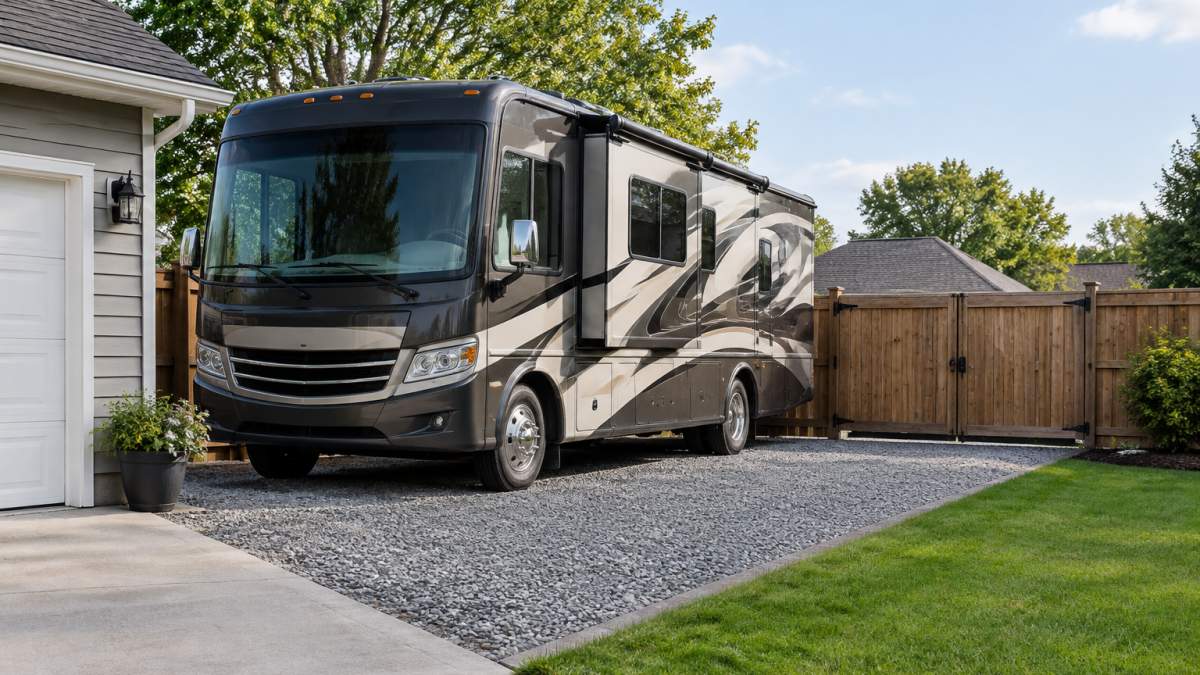
Before you park long term, pull three documents: the municipal zoning code section that addresses recreational vehicles, the zoning map or parcel report for your address, and any overlay district or homeowners association covenant that adds restrictions. Many towns publish these online through a planning department portal, and the code enforcement office can confirm how the code applies to your lot. Keep a dated record of what you confirm and who you spoke with.
Setbacks, Surface and Vehicle Overhang
Setbacks are the minimum distances a parked RV must keep from property lines, sidewalks and the street. Requirements vary by municipality and sometimes by zoning district, so measure your lot and compare against the code rather than assuming a standard distance.
Vehicle overhang, the part of the RV that extends past the parking pad, is often restricted as well. Compare your figures against guidance on the right RV parking space dimensions.
Permits and Enforcement
Some jurisdictions require a permit before a long-term RV pad is built or before a vehicle is parked for an extended period.
Enforcement usually starts with a written notice and a deadline to comply. Continued violations can bring fines, and in some cases the municipality can tow the vehicle.
Watch out: a pad built without a permit can be treated as a separate violation from the parking itself, so confirm permit status before you pour concrete or place gravel.
RV Parking on a Residential Street: Time Limits and Right-of-Way Rules
Street parking is where long-term RV owners most often run into trouble. Many towns limit how long an oversized vehicle may remain on a residential street, and some prohibit overnight parking of RVs entirely. Right-of-way rules also apply, meaning the vehicle may not block sidewalks, hydrants or sight lines at intersections.
Time limits differ widely. Some municipalities set a fixed number of consecutive hours or days, while others prohibit RV parking on residential streets altogether.
Long Term RV Park Rules: Occupancy Agreements and Stay Limits
RV parks and campgrounds operate under their own agreements, and those agreements often set stay limits that differ from what a city allows.
Read the occupancy agreement before you sign, and ask the park how stay limits are measured. You can also compare the best RV parking options nearby while you weigh your choices. Some parks count days in a rolling window, while others count a calendar period.
Long-Term RV Storage Requirements and Costs
Storing an RV for months is a different task from parking it for a few weeks. Learn how to protect your RV from weather damage while it is in storage.
Costs depend on the size of the space, the length of the agreement and the level of security offered. Pricing depends on the facility, site size and contract terms, so request a quote for current figures.
The article breaks down the main factors that shape long-term RV storage requirements and costs.
| Factor | What to check | Note |
|---|---|---|
| Storage type | Parking vs. storage vs. occupancy | Each can trigger different rules |
| Battery and tires | Maintenance before long sits | Unused RVs can degrade |
| Space size | Length and width of the unit | Measure the full vehicle footprint |
| Security | Gates, lighting, cameras | Ask what the rate includes |
| Cancellation terms | Early exit conditions | Review before signing |
| Pricing | Quote for current figures | Varies by facility and contract |
How to Verify Local Rules and Checklist for Legal Long-Term Parking
Local rules change, and online summaries can be outdated. The reliable approach is to verify each requirement against the current municipal code and confirm the answer with the office that enforces it. This section gives you a repeatable workflow so you can document what applies to your address before you commit to a long-term spot.
Step-by-Step Verification Workflow
- Identify every authority with jurisdiction. For a private lot, that usually means the municipal or county planning department and code enforcement office. For a street, add the police department or public works department. For an RV park, the park operator and any state or local health authority that licenses the park. For public land, the land management agency that administers the site.
- Pull the current code section. Ask the planning department for the code section that addresses recreational vehicles, and confirm the effective date. Codes are amended, so a section you read last year may no longer be current.
- Confirm how the code applies to your parcel. Give the planner your address or parcel number and ask which zoning district applies and whether any overlay or special district adds restrictions.
- Ask about permits. Confirm whether a permit is required for the pad, the parking, or both, and ask for the application form and the inspection sequence.
- Confirm enforcement and appeal. Ask how complaints are handled, what the notice and appeal deadlines are, and whether towing is authorized.
- Document everything. Save the code section, the permit form, and a dated note of each conversation with the name of the person you spoke with. If a dispute arises later, this record is your best evidence of good-faith compliance.
Compliance Checklist
Use this checklist before you park an RV for the long term:
- Confirm the municipal code or zoning rule for RV parking on your lot, including the effective date.
- Confirm the zoning district and any overlay or HOA covenant that adds restrictions.
- Measure setbacks from property lines, sidewalks and the street against the code.
- Confirm the surface is a legally permitted pad, not bare grass or dirt, and check any impervious-surface cap.
- Measure the full vehicle length, including slide-outs and rear accessories, against overhang limits.
- Ask whether a permit is required for the pad or the parking, and get the application and inspection steps.
- For street parking, confirm time limits, overnight restrictions and right-of-way rules with police or public works.
- For an RV park, read the occupancy agreement, stay limit, site standards and termination terms.
- For storage, confirm security features, cancellation terms and what the quoted rate includes.
- Record the name, date and answer for each office you contact, and keep copies of the code sections you relied on.
Watch out: a verbal answer from one office can conflict with the written code, so ask for the answer in writing or cite the code section in your notes.
Choosing a Secure Long-Term Spot for Your RV at Big Sky Self Storage Yards
Big Sky Self Storage Yards offers outdoor storage for RVs, boats and other equipment, with fenced yards, locking gates and onsite lighting and security cameras. Our 12' x 40' parking spaces are sized for XL RVs, and the facility sits near major crossroads with easy access to I86. Visit the Big Sky Self Storage Yards pricing page for current prices, or request a quote, and confirm how our terms apply to your situation before you commit.
Frequently Asked Questions
What are the requirements for parking an RV long term?
Requirements depend on where the RV sits. Local zoning codes, municipal ordinances and HOA rules usually set limits on setbacks, parking surface, vehicle length and whether the RV can be occupied. Many jurisdictions require the RV to be parked on a legally paved or improved surface and kept clean and in operable condition. Check your city or county planning department before committing to a long stay, because rules can differ even between neighboring towns.
Can I park an RV on a residential street for an extended period?
Most residential streets are subject to time limits on parking, and many municipalities restrict oversized vehicles or prohibit RVs from being parked on streets for more than a set number of days. Some cities ban overnight street parking of RVs entirely. Parking in a public right-of-way can also draw enforcement and fines if the vehicle blocks sightlines or hydrants. Confirm the local parking ordinance with your municipal clerk or police non-emergency line.
Do I need a permit to park an RV on private property?
A permit is not always required, but some jurisdictions require a zoning permit or a temporary-use permit if an RV is parked on private property for an extended period. If you plan to live in the RV, the rules tighten because occupancy is regulated separately from parking. Ask your local zoning or building department whether a permit applies to your situation. Even where no permit is needed, you may need to meet setback and surface requirements.
How long can an RV stay at an RV park?
RV parks set their own stay limits in the occupancy agreement or park rules. Some parks allow stays of 30 days or less, while others offer monthly or seasonal sites with no fixed end date. Stay limits are often tied to local zoning, so a park may be unable to host long-term residents even if it accepts RVs. Read the park's rules and ask whether the site is classified for transient or permanent occupancy before you sign anything.
What should I check in an RV park's long-term parking rules?
Review the occupancy agreement, stay limits, site standards, and any rules on clutter, skirting, awnings and vehicle condition. Confirm what utilities are included, such as water, sewer and electric hookups, and whether they are metered separately. Ask about notice requirements for ending the stay, deposits and whether the park enforces a maximum vehicle length. Also check whether the park allows you to use the address for mail or registration.
Where can I park an RV long term?
Long-term RV parking is typically available on private property that meets zoning rules, at licensed RV parks, at county campgrounds with stay limits, and at dedicated outdoor RV storage yards. Public streets and public land usually carry strict time limits. Storage yards are often the simplest option for stored, unoccupied RVs, while RV parks suit occupied vehicles. Choose the option that matches whether you plan to store the RV or live in it.
Can I live in an RV while it is parked on private property?
Living in an RV on private property is restricted in many areas, even when parking the vehicle is allowed. Some zoning codes treat an RV used as a dwelling like a residence, which may require a permit or be prohibited outside an RV park. Utility connections, sanitation and fire safety are also regulated. Check with the local zoning office before moving in, since occupancy rules are often stricter than parking rules.