 blog
Book Secure Outdoor Storage Space: A 2026 Guide
Table of Contents
- What to Expect When You Book Secure Outdoor Storage Space
- Key Features to Compare Before You Book
- Outdoor Storage for ATV Gear: What to Look For
- Secure RV Storage Facilities: Sizing and Access
- Contractor Equipment Storage Solutions for Growing Businesses
- Insurance, Liability, and Climate Considerations
- How to Book Your Secure Outdoor Storage Space
- Conclusion
- Frequently Asked Questions
Last Updated: October 4, 2026
What to Expect When You Book Secure Outdoor Storage Space
Booking secure outdoor storage space is the process of renting a fenced, monitored yard or parking spot for vehicles, equipment, or materials you cannot keep at home or on a job site.
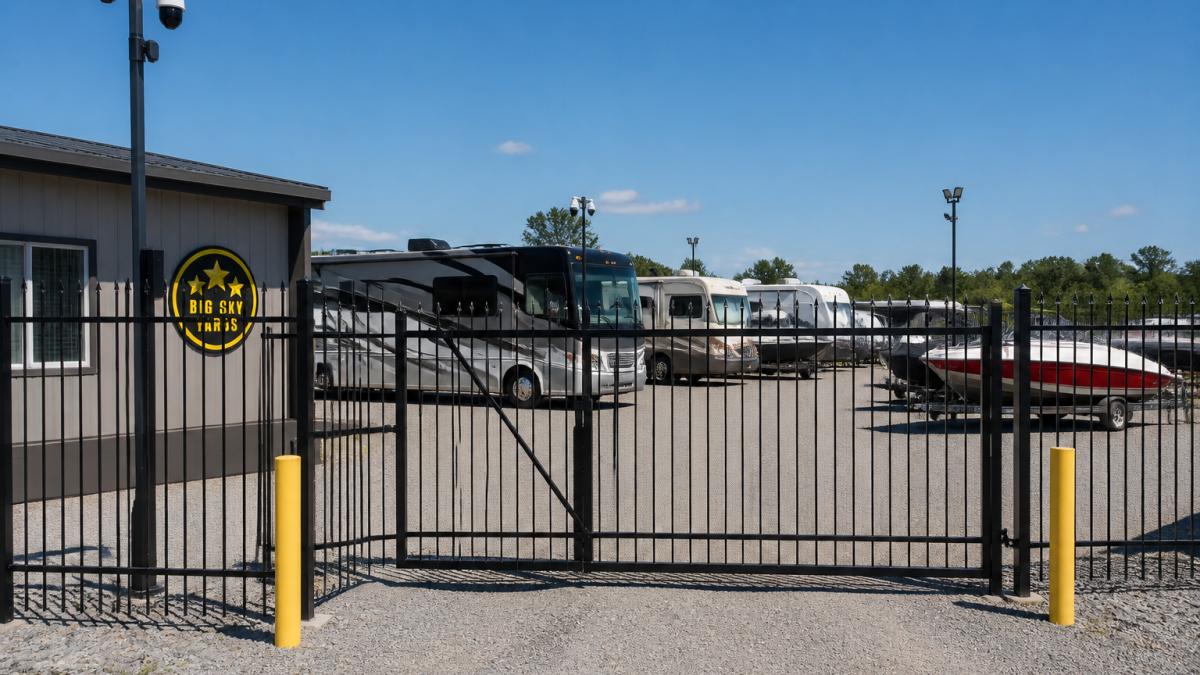
Most first-time renters shop on price per square foot and ignore access, surface, and security, then discover their trailer does not fit the gate or the gravel turns to mud after a storm.
Below, we break down how to compare facilities, what to look for across ATV, RV, and contractor storage, and how to book without signing terms you will regret.
Key Features to Compare Before You Book
Three things separate a yard you renew for years from one you abandon in three months: security infrastructure, access, and usable space. Price is the last filter, not the first.
Security Infrastructure
Look for layered protection, not a single measure. A fence alone stops casual theft; a fence plus lighting, cameras, and a lockable gate stops most of it. Ask whether cameras cover the back rows or only the entrance.
Access and Location
Convenience decides whether you actually use the space. A yard 40 minutes away turns a 10-minute equipment grab into a half-day trip. Check gate hours, code or key access, and proximity to major highways.
Space and Capacity
Measure before you book. A 12' x 40' spot fits a full-size enclosed trailer or an XL RV, but a spot listed as "large" elsewhere may not. Confirm the surface too: gravel drains well, dirt does not.
| Feature | What to Check | Why It Matters |
|---|---|---|
| Fencing | Height, gate lock type | Stops casual theft |
| Lighting | Coverage of back rows | Deters after-dark break-ins |
| Cameras | Count and retention | Helps recovery if theft occurs |
| Surface | Gravel vs. dirt | Prevents mud and rust |
| Access | Hours, code system | Determines real usability |
| Spot size | Measured, not listed | Prevents fit problems |
Outdoor Storage for ATV Gear: What to Look For
ATVs, side-by-sides, jet skis, and seasonal gear need a spot that handles weather and theft at once. Resin and UV-resistant covers slow sun damage, but they do not stop someone from rolling a four-wheeler onto a trailer. Lockable, monitored space beats a tarp in the driveway.
Sizing an ATV or Powersports Spot
Measure the machine, not the marketing label. A full-size ATV runs roughly 6 to 7 feet long and 4 feet wide; a two-seat side-by-side can stretch past 10 feet and 5 feet wide. Add 2 to 3 feet on every side for walking room and swinging a trailer tongue. A 10' x 20' spot holds one ATV plus a small trailer; a 10' x 30' spot handles a side-by-side with a trailer hitched.
Surface and Drainage
A common mistake is storing an ATV on a dirt pad. Water pools underneath, rust starts at the frame and axle, and by spring you are replacing bearings. Look for graded gravel or asphalt with a slight slope away from the parking rows so stormwater runs off. Flat dirt with no drainage means mud in spring and dust in summer, both of which work into seals and air filters.
Anchoring and Theft Prevention
A padlock on a container is one layer; anchoring the machine itself is the layer most renters skip. Chain or cable the ATV frame, not the handlebars or a plastic rack, to a fixed anchor point inside your space. If the facility does not provide anchors, ask about installing a ground anchor or concrete block. A hardened-steel chain with a disc-style padlock resists bolt cutters far better than a standard padlock and cable. For trailers, use a coupler lock and wheel chock or boot so they cannot simply be hitched and towed.
Climate-Specific Prep
Storage prep changes with the climate. In cold-winter regions, freeze-thaw cycles crack hoses and a connected battery loses charge and can freeze: drain the fuel or add stabilizer, store the battery indoors, and elevate the machine off bare ground. In humid summers, mold grows on upholstery and in the air intake; use a breathable cover rather than a moisture-trapping tarp, and crack or remove the seat if allowed. In arid, dusty regions, seal the air intake and cover the carburetor to keep grit out.
Organizing Smaller Gear Inside Your Space
For smaller items, a deck box or hollow storage container inside your space keeps tools and riding gear organized and out of sight. Add a padlock or electronic lock for two layers of protection, and keep the container on a pallet or blocks so the bottom does not rust through.
Secure RV Storage Facilities: Sizing and Access
Secure RV storage facilities are yards built for long vehicles and the turning radius they need.
Sizing is where most RV owners guess wrong. Measure bumper to bumper, then add a few feet for the hitch and tongue. If you tow a boat behind the RV, ask whether both fit in one spot or require separate spaces.
Access matters just as much for RVs. Long vehicles need wide gates and straight approaches. A tight turn into a crowded row is how mirrors get sheared off. Ask about gate width before you commit.
Contractor Equipment Storage Solutions for Growing Businesses
Contractor equipment storage solutions solve a specific problem: you have outgrown the driveway but do not want a second warehouse lease.
The setup that works for most growing crews is a yard space paired with a 20' container. The container holds tools, materials, and supplies under lock.
What most guides miss is that contractors need to move fast. If grabbing a ladder takes an hour of driving, the yard is failing you.
For anchoring, chain heavy equipment to fixed points inside your space and use a heavy-duty padlock on the container.
Insurance, Liability, and Climate Considerations
Insurance and liability are the topics competitors gloss over, and they decide whether a theft or storm loss comes out of your pocket or someone else's.
Who Actually Insures What
Most self-storage and outdoor yard facilities do not insure your property. Their coverage protects the building, fence, and lot, not your RV, ATV, trailer, or tools. If a storm drops a limb on your boat or a thief cuts the gate lock, the facility's policy generally will not pay you. Your own policy is the one that matters.
Start by checking three policies you may already hold:
- Auto policy, many auto policies extend coverage to a trailer, RV, or ATV while it is parked, but only if the vehicle is registered and insured as a vehicle. Confirm whether the policy covers the unit at a storage location, not just at your home.
- Homeowners or renters policy, these often cover personal property stored off-site, but many cap off-premises coverage at a percentage of your contents limit (commonly 10 percent) and may exclude motorized vehicles entirely. Read the off-premises section, not just the summary.
- Business or commercial policy, if the equipment belongs to a business, a homeowners policy will not cover it. Contractors need a commercial inland marine or equipment floater policy that names the stored items and the storage location.
Questions to Ask Before You Move Anything In
Ask the facility three questions in writing: Does the lease require me to carry insurance on stored property? Does the facility require proof of insurance before I move in? What happens if a storm, fire, or theft damages my vehicle on the lot? Get the answers in the lease, not a phone call, a facility that cannot answer clearly has not thought about your risk.
Liability: Who Pays When Something Goes Wrong
Liability runs both directions. If your trailer rolls into a neighbor's boat, your auto or renters policy may respond. If a facility employee damages your equipment, the facility's liability may respond, but only if the lease has no waiver. Read the lease for a limitation-of-liability clause and a requirement that you carry your own insurance; those clauses are common and enforceable in most states, so do not assume the facility is on the hook.
Climate Drives the Rest
Climate drives the rest of your prep. In cold-winter regions, freeze-thaw cycles crack hoses and batteries lose charge; drain fuel systems, disconnect batteries, and elevate items off the ground. In humid summers, mold grows on upholstery; use breathable covers and leave air gaps. In arid, dusty regions, seal intakes and cover exposed surfaces. In coastal or flood-prone areas, ask about the lot's elevation and drainage before you book, a spot that floods once a season costs more in rust and mold than the rent saves.
How to Book Your Secure Outdoor Storage Space
Booking takes about 15 minutes with your measurements ready. Here is the sequence we recommend:
- Measure your vehicle or equipment, including hitches and overhangs
- List your must-haves: gate hours, surface type, container access
- Call or check the facility's site for current availability and pricing
- Confirm spot dimensions and gate width match your measurements
- Ask about lease terms and cancellation policy before signing
- Review your insurance coverage for stored property
- Reserve the spot and confirm your access method
Ask about short-term options if you only need space for a season.
At Big Sky Self Storage Yards, we keep the process simple: double-secured fenced yards, locking gates, onsite lighting, and cameras, plus 20' containers and 12' x 40' spots for the vehicles and equipment that need them. You can check current pricing and availability on our website.
Conclusion
Finding storage that protects your equipment takes more than a low monthly rate. It takes the right spot size, a secure surface, layered security, and terms you can live with. Big Sky Self Storage Yards offers double-secured fenced yards with locking gates, optional 20' containers for contractors, and 12' x 40' parking spots for XL RVs, all with onsite lighting, security cameras, and quick access to I86 and surrounding areas. Get started with Big Sky Self Storage Yards and store your gear in one reliable, protected location.
Frequently Asked Questions
What security features should I look for in an outdoor storage yard?
Look for a fully fenced perimeter, locking gates, onsite lighting, and security cameras. The best facilities combine these layers so that an intruder has to get past multiple barriers. Ask whether the yard is staffed or monitored 24/7, and whether individual units or parking spots have their own locks. A double-secured yard with a gate that requires a code or key is more resistant to theft than an open lot.
Is outdoor storage safe for high-value equipment and vehicles?
Yes, if the facility has strong security. Fenced yards with locking gates, cameras, and lighting deter most theft. For extra protection, anchor your equipment or use a heavy-duty lock on trailers and containers. Keep an inventory of serial numbers and take photos of your items.
How do I determine the right size for my outdoor storage space?
Measure your vehicle or equipment, including any trailer hitch or attachments. For RVs, a 12' x 40' spot fits most full-size motorhomes and travel trailers. For ATVs, a 10' x 20' space is usually enough for two or three units plus gear. Contractors often need a 20' container plus yard space for materials. When in doubt, size up: the cost difference is small compared to the hassle of a tight fit.
What is the difference between a standard parking spot and a container storage unit?
A standard parking spot is an open area, often gravel or paved, where you park your vehicle or trailer. A container storage unit is a secure, weather-resistant metal box (often 20 feet long) that you can lock. Containers protect against rain, snow, and UV damage, and they keep tools and materials out of sight. Some facilities offer a combination: a container plus adjacent yard space for larger items.