 How-to
Outdoor Storage for Heavy Equipment: 2026 Guide
Table of Contents
- Outdoor Storage for Heavy Equipment: What Actually Works
- Comparing Outdoor Storage Options for Heavy Equipment
- What to Look for in a Heavy Equipment Storage Yard
- Construction Equipment Storage: Sizing, Access, and Site Prep
- Equipment Storage Security: Locks, Lighting, and Monitoring
- Weatherproof Storage for Heavy Machinery: Protecting Your Investment
- Permits, Zoning, and Environmental Rules for Equipment Storage
- Frequently Asked Questions
Last Updated: October 16, 2026
Outdoor Storage for Heavy Equipment: What Actually Works
Outdoor storage for heavy equipment means keeping machinery, trailers, and attachments on a dedicated exterior site that is graded, fenced, and secured rather than under a roof.
A workable storage plan comes down to three things: the surface under the machine, the barrier around it, and the rules that govern the site. Get them right and your equipment sits ready to roll; get them wrong and you are buying parts instead of bidding jobs.
Below, we break down every major outdoor storage option, how to size a space for real machinery, and the site prep, security, and permitting questions most guides skip.
Comparing Outdoor Storage Options for Heavy Equipment
Five categories cover nearly every equipment storage need, each trading cost against protection differently. The right pick depends on what you store, how long it sits, and whether you own or rent the ground.
| Option | Best For | Weather Protection | Security Level | Relative Cost |
|---|---|---|---|---|
| Storage shed | Tools, small equipment | High | High | Highest |
| Carport | Tractors, trailers | Roof only | Medium | Medium |
| Equipment shelter | Mid-size machinery | Medium to high | Medium | Medium |
| Fabric structure | Seasonal, overflow | Medium | Low to medium | Lowest |
| Shipping container | High-value, lockable gear | High | Very high | Medium |
Storage Sheds, Carports, and Equipment Shelters
A storage shed is a fully enclosed structure with walls, a roof, and a door, offering the most complete protection on this list. Resin and plastic sheds suit tools, yard equipment, and small attachments because they resist rot and need almost no upkeep.
Carports and equipment shelters sit in the middle ground. A carport is a roof on posts, open on the sides, keeping rain and direct sun off a tractor or trailer without walling it in.
What most guides miss is that an open carport protects the top of a machine and almost nothing else.
For heavy equipment, the deciding variable is usually clear height and door width, not floor area.
Fabric Structures and Shipping Containers
Fabric structures use a steel frame under a heavy tarp or vinyl skin, the fastest, cheapest way to get a lot of covered space. They work well for seasonal overflow, hay, and equipment you rotate in and out.
Shipping containers go the other direction. A steel container is lockable, weather-tight, and extremely hard to break into, ideal for tools, attachments, and anything a crew would otherwise leave in a truck bed.
A practical setup often pairs the two: a container for the tools and a fenced pad or carport for the machines themselves.
The heavy-equipment angle most comparisons skip is that containers and fabric structures solve different problems. A container is a vault for things you cannot replace quickly, such as diagnostic tools, spare hydraulic hoses, and buckets.
What to Look for in a Heavy Equipment Storage Yard
The single most important feature of a heavy equipment storage yard is a graded, load-bearing surface that keeps machines out of mud and standing water. Everything else, fencing, lighting, access, is built on top of that foundation.
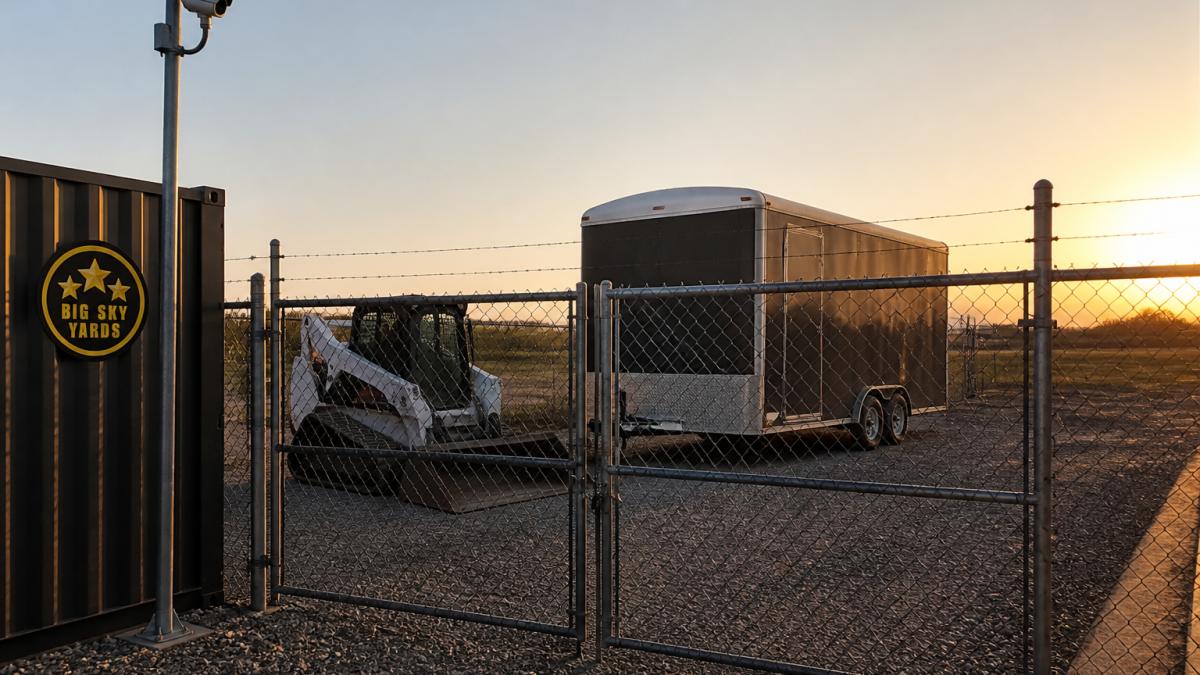
When you evaluate a yard, check these in order:
- Surface and drainage. Gravel or compacted stone that sheds water beats bare dirt every time. Ask how the site handles a heavy rain.
- Gate and access width. Measure your widest trailer against the gate opening before you commit.
- Security infrastructure. Locking gates, onsite lighting, and cameras should be standard, not add-ons.
- Space sizing. Confirm the actual footprint, not the marketing name. A 12' x 40' spot fits a full-size enclosed trailer with room to open the doors.
- Location and drive time. A yard near major crossroads and highways saves hours over a season.
Construction Equipment Storage: Sizing, Access, and Site Prep
Construction equipment storage fails most often because the space was sized for the machine, not the machine plus its trailer, attachments, and turning room. Plan the footprint around your largest combined load.
Start with real dimensions. A compact track loader, its trailer, and a bucket attachment can easily consume a 12' x 40' footprint once you allow for hitching and door swing. Add clearance on every side to walk around and inspect the machine.
How to measure a machine for storage
Measure the machine in its stored configuration, not its working one: boom down, ROPS folded if it folds, attachment removed or accounted for. Then measure three numbers:
- Length from the front of the attachment to the rear of the machine, plus the trailer tongue if it stays hitched.
- Width at the widest point, which is usually the tires or the bucket, not the cab.
- Height at the tallest point, which is usually the ROPS or the exhaust stack.
Write those numbers down and add clearance: about 3 feet on each side for walking and inspection, 2 to 3 feet front and rear for hitching and door swing, and at least 1 foot of headroom. A machine 6 feet wide and 9 feet tall effectively needs a 12-foot-wide, 10-foot-clear opening to be usable every day.
Access and turning geometry
Access is where most storage plans break. You need a gate wide enough for your trailer, a turning radius you can actually make, and a route in and out that does not require a three-point turn every visit.
A common pattern is a gate sized for the machine but not the trailer. A 102-inch-wide enclosed trailer needs a gate opening of at least 12 feet to enter at an angle without clipping a post; a 90-degree turn off a narrow lane may need 14 feet or more, plus a flared apron so the trailer tires do not ride the fence line. Measure the turning path with your longest combined load, then add a margin.
Ground preparation and load-bearing foundations
Site prep matters as much as size. A load-bearing foundation, whether compacted gravel or a concrete pad, spreads a machine's weight so it does not sink and shift. Soft ground under a heavy trailer causes ruts, and ruts become low spots that hold water.
A few practical rules apply to almost any heavy-equipment pad:
- Grade for drainage. Slope the pad so water runs away from where machines sit, typically a gentle fall of about 1 to 2 percent. Flat pads pool; steep pads erode.
- Build up, do not dig in. Compacted crushed stone over a geotextile fabric keeps aggregate from migrating into soft subsoil and keeps the surface firm under repeated loads.
- Anchor anything with a roof. Carports, shelters, and fabric structures need ground anchors rated for wind uplift, because an empty structure is a sail.
- Keep the pad above the surrounding grade. A pad slightly proud of the surrounding ground sheds water instead of collecting it.
Equipment Storage Security: Locks, Lighting, and Monitoring
Equipment storage security rests on layers, not a single lock. A gate stops casual access, lighting removes cover, and cameras create a record.
The most common mistake is relying on a padlock and nothing else. A lock on an unlit gate in a dark corner is an invitation. Pair every lock with light, and every light with a camera; thieves avoid well-lit, watched sites because the risk goes up and the payoff goes down.
Practical layers to look for or build:
- Locking gates with hardened hardware that resists cutting
- Onsite lighting that covers gates, aisles, and parking spots
- Camera coverage with recordings you can actually retrieve
- Fencing tall enough and tight enough to slow anyone climbing through
- A site layout with clear sightlines, so nothing hides in a blind corner
Weatherproof Storage for Heavy Machinery: Protecting Your Investment
Weatherproof storage for heavy machinery is less about keeping a machine perfectly dry and more about controlling the two things that cause the most damage: water and UV light.
Water gets into hydraulic systems, electrical connections, and bearings. A machine parked on ground that drains well avoids the worst of it, because standing water wicks up into the undercarriage.
Sunlight is the slower killer. UV degrades tires, hoses, belts, and plastic components over years of exposure. A machine parked in full sun ages faster than one under cover, even if both stay dry.
Protection and maintenance go together. Before a machine sits for a season, service it, top off fluids, and disconnect or maintain the battery.
Permits, Zoning, and Environmental Rules for Equipment Storage
Permits and zoning decide whether you can legally keep equipment on a given piece of ground, and they are the question most guides never raise. Rules vary widely by state, county, and municipality, so the answer is always local.
A few things commonly trigger a permit or a zoning review:
- Building a permanent structure such as a shed or container pad
- Storing equipment on a lot not zoned for commercial or industrial use
- Operating a storage yard in a residential or mixed-use area
- Storing fuel, fluids, or materials that fall under environmental rules
Environmental requirements matter if you store anything that can leak. Fuel, oil, and hydraulic fluid are regulated in many jurisdictions, and a spill on an uncontained surface can create liability far exceeding the value of the equipment.
The same logic applies when you rent space. A well-run storage yard has already handled the zoning and environmental questions for its site, which is one reason renting a spot is often simpler than converting your own land.
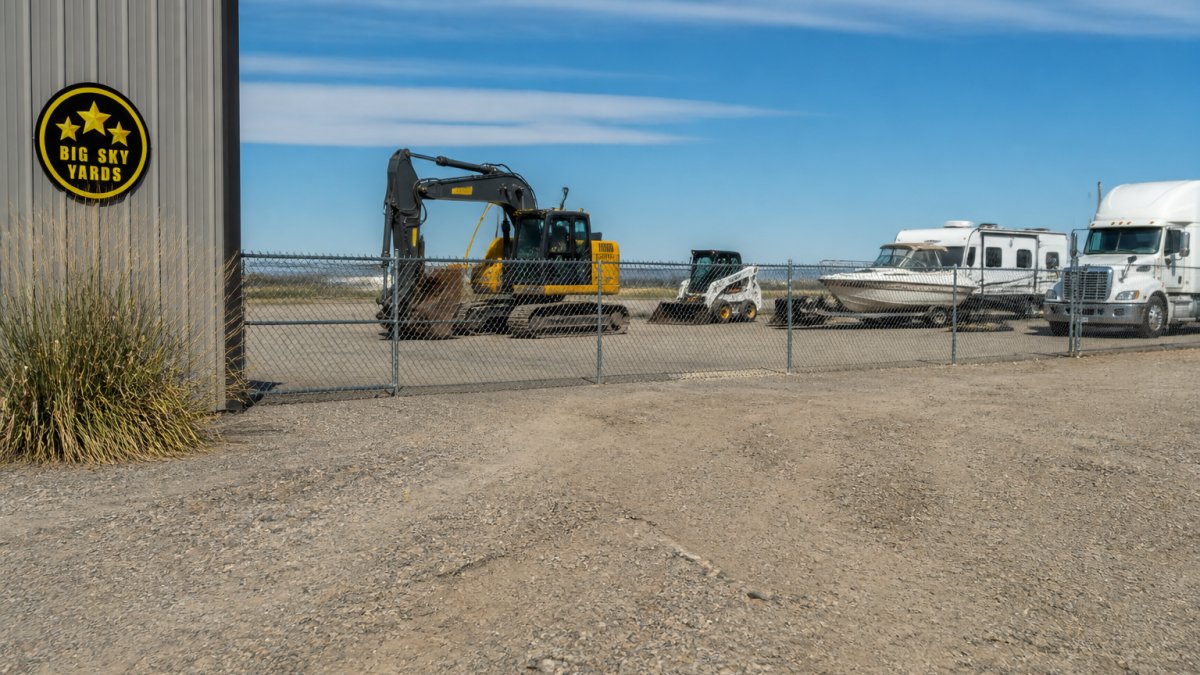
Finding space that is graded, fenced, lit, and legal is harder than it sounds, and getting it wrong costs more than the rent ever would. Big Sky Self Storage Yards offers double-secured fenced yards with locking gates, optional 20' containers for tools and materials, and 12' x 40' parking spots sized for full-size enclosed trailers and XL RVs.
Frequently Asked Questions
What is the best weatherproof outdoor storage option for heavy equipment?
It depends on how long you're storing and how much weather exposure matters. Steel or metal shelters handle snow loads and wind best, while fabric structures cost less and go up faster but need replacement covers every few years. For machinery stored outside year-round, a heavy equipment storage yard with a gravel pad plus a cover or container gives you the best balance of protection and cost.
What security features should an outdoor equipment storage yard have?
Look for a fenced perimeter with locking gates, onsite lighting, and security cameras covering the yard. Double-secured yards, where you pass through a gate and then lock your own container or space, add a second layer. Equipment storage security also depends on your own locks, so use hardened padlocks and record serial numbers.
What should you do before leaving heavy equipment in outdoor storage?
Drain fuel or add a stabilizer, disconnect the battery, and top off fluids to prevent corrosion. Clean off dirt and debris, especially around hydraulic fittings, and apply a protective coating to exposed metal. Remove valuables, lock the cab, and photograph the machine from several angles. For weatherproof storage for heavy machinery, park on a hard surface rather than bare dirt so moisture doesn't wick up into the undercarriage.
Do you need permits to store heavy equipment on your own property?
Often yes, depending on local zoning. Many jurisdictions classify heavy equipment storage as a commercial or industrial use, which may not be allowed in residential zones. Check setback rules for sheds and carports, and ask about stormwater requirements if you're paving a new pad. A quick call to your local planning office before you build or rent space can save you a citation later.