 How-to
Outdoor Storage Pricing for Contractors: 2026 Guide
Table of Contents
- Outdoor Storage Pricing for Contractors: What Actually Drives Your Monthly Bill
- Construction Equipment Storage Costs: Breaking Down the Line Items
- How to Estimate the Space Your Equipment and Materials Need
- Outdoor Storage Yard Rental Rates: Per-Unit, Per-Square-Foot, and Per-Acre Math
- Equipment Storage Containers for Contractors: When They Beat Open Yard Space
- Secure Storage for Construction Materials: Security, Zoning, and Contract Terms
- Regional and Seasonal Price Variation in Outdoor Storage Pricing
- Conclusion: Turning Pricing Research into a Workable Yard Budget
- Frequently Asked Questions
Last Updated: October 5, 2026
Outdoor Storage Pricing for Contractors: What Actually Drives Your Monthly Bill
Outdoor storage pricing for contractors comes down to four variables: how much space you rent, how it's covered, how you're billed, and what the yard charges beyond base rent.
At Big Sky Self Storage Yards, we watch contractors compare quotes that look identical on the surface and turn out to be nothing alike underneath.
The gap between those two is rarely the headline number. It's the access terms, the deposit, the insurance requirement, and whether the rate is quoted per month or per year.
Below, we break down what actually shows up on a contractor's storage bill, how to size the space you need, and how to compare a per-unit quote against a per-square-foot quote without getting fooled.
Construction Equipment Storage Costs: Breaking Down the Line Items
Construction equipment storage costs break into two buckets: what you pay for the space, and what you pay to use it the way you need to. The first is negotiable through size and term. The second is where most contractors get surprised.
Base rent and what it typically covers
Base rent is the recurring charge for the space itself. What it includes varies by facility, and that's the first thing to pin down.
A common approach is for base rent to cover:
- The physical footprint, whether a defined unit, a numbered lot, or a marked parking bay
- Perimeter fencing and a locking gate
- Onsite lighting and camera coverage in secured yards
- Ordinary access during posted hours
Some yards bundle container rental into the base rate. Others bill it separately. Neither is wrong, but you need to know which one you're looking at before you compare two quotes side by side.
What base rent almost never covers: electricity for a container you power yourself, damage to the surface from heavy equipment, or anything beyond your marked boundary.
Deposits, access fees, and insurance requirements
Deposits are usually refundable and sized to one month's rent, though that varies. Access fees are the quieter line item. Some yards charge for after-hours gate entry, extra key fobs, or additional authorized drivers on your account.
Insurance is the one that changes the math most. Many facilities require you to carry coverage on stored equipment and materials, and some require proof before you get a gate code.
How to Estimate the Space Your Equipment and Materials Need
Sizing your space correctly is the fastest way to cut your bill, because over-renting is the single most common waste in contractor storage. Most contractors guess high, pay for empty gravel for a year, and never revisit it.
Here's a practical method. List every asset that will live in the yard, then measure the footprint of each one, including the trailer tongue or hitch overhang.
| Asset Type | Typical Footprint | Storage Notes |
|---|---|---|
| Full-size pickup | About 20 ft long | Needs drive-up access |
| Enclosed cargo trailer | 16-24 ft long | Needs room to unhitch |
| Mini excavator | 10-14 ft long | Track width matters for gates |
| Scissor lift | 8-12 ft long | Height clearance for covered space |
| Material laydown (lumber, pipe) | Varies by bundle | Keep off bare ground if possible |
| Palletized supplies | About 4 ft x 4 ft per pallet | Stack height limited by racking |
Add 3 to 4 feet of clearance around anything you need to walk around or hitch to. Then add a turning radius: if you can't pull in and back out without a three-point turn, you've undersized the bay.
A simple rule: measure your longest single asset, then add the length of your longest trailer. If both need to sit in the same bay, that's your minimum.
Outdoor Storage Yard Rental Rates: Per-Unit, Per-Square-Foot, and Per-Acre Math
Outdoor storage yard rental rates are quoted three different ways, and that's the root of most comparison confusion. A per-unit rate, a per-square-foot rate, and a per-acre rate can all describe the same patch of gravel.
Per-unit pricing is the simplest. You rent a defined space, usually a numbered lot or a marked bay, and the rate is fixed regardless of what you put in it.
Per-square-foot pricing scales with the footprint. It's the fairest structure when you need an odd shape or a partial lot, and it's the structure that rewards you for measuring accurately.
Per-acre pricing shows up for large contractor yards, fleet parking, and material laydown areas. It's usually the lowest cost per square foot, but it comes with minimum commitments and often a longer lease.
A simple calculator method for contractors
Use this to normalize any quote into a monthly cost per square foot, so you can compare apples to apples:
- Write down the monthly rate. If it's annual, divide by 12.
- Measure the usable footprint. Not the fenced area, the space you can actually park on.
- Divide rate by square footage. That's your true monthly cost per square foot.
- Add the recurring extras. Insurance rider, access fees, container rental if separate.
- Divide again. Now you have a fully loaded cost per square foot.
Run that on three quotes and the cheapest headline rate often stops being the cheapest option. A yard that quotes low but charges separately for the container, the gate fob, and after-hours access can land above a yard that bundles everything into one rate.
That's also why regional and seasonal variation matters so much. Rates in a market with tight industrial land will run higher than a market with open acreage, and winter storage demand for boats and RVs pushes seasonal pricing in many areas.
For broader context on how commercial land values feed into storage rates, the U.S. Bureau of Labor Statistics producer price indexes track input costs across the economy, and industrial land markets move with them.
Equipment Storage Containers for Contractors: When They Beat Open Yard Space
Equipment storage containers for contractors make sense when the risk of theft, weather damage, or unauthorized access outweighs the cost of the container itself. An open lot gives you space. A container gives you space plus a locked steel box.
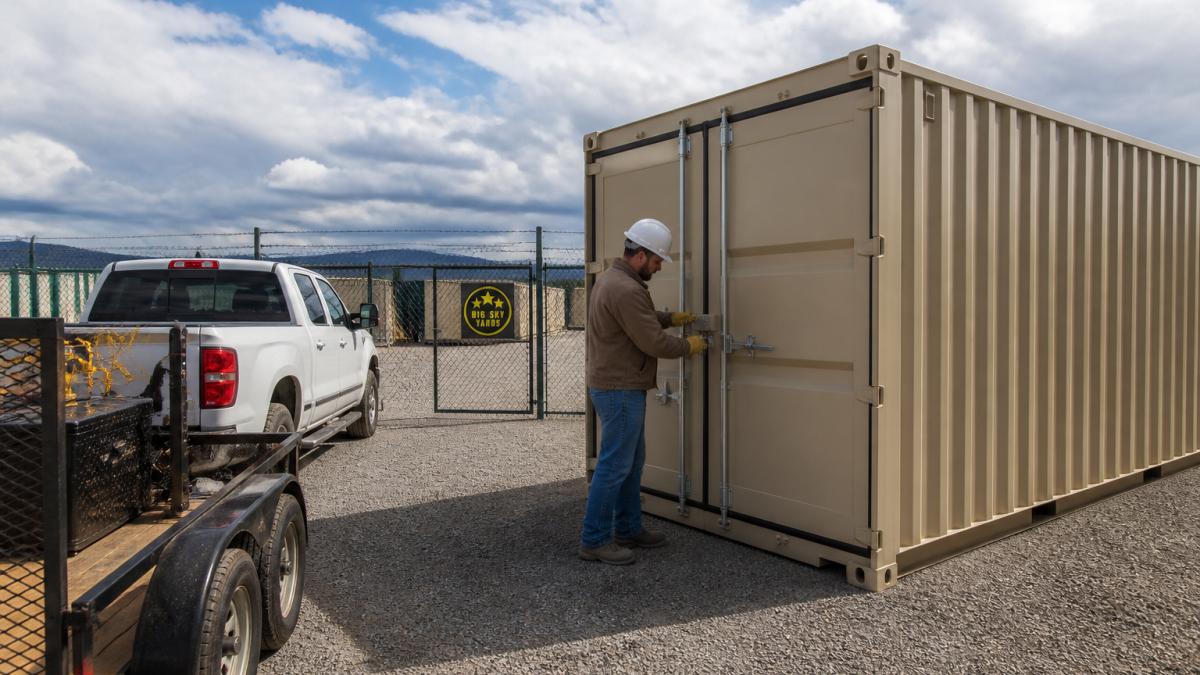
The trade-off is access speed. You can pull a trailer out of an open bay in two minutes.
Containers also change what you can store. Hand tools, copper, small engines, and anything with resale value belong inside steel, not on a pallet under a tarp. Bulk materials like lumber, pipe, and aggregate are usually fine in the open.
Some yards include a container with specific yard spaces rather than renting it separately. That bundling matters when you're comparing quotes, because a container line item can swing the total significantly.
Secure Storage for Construction Materials: Security, Zoning, and Contract Terms
Secure storage for construction materials depends on three things: physical security, whether the site is legally allowed to hold what you're storing, and what the contract lets the operator do if you fall behind.
Physical security is the visible part. Fenced perimeters, locking gates, onsite lighting, and camera coverage are the standard package.
Zoning is the part contractors miss. Not every lot is zoned for commercial equipment storage or material laydown. If a yard is operating outside its permitted use, you can be asked to vacate with little notice, and that's a business interruption you didn't budget for.
Contract terms are the third leg. Read for:
- Term length. Month-to-month, annual, or multi-year, and what happens at renewal
- Early termination. Whether you can exit if work slows, and what penalty applies
- Notice period. How much warning you must give before vacating
- Lien and default language. What the operator can do to your equipment if you miss a payment
- Assignment. Whether you can hand the space to another contractor mid-term
That last one matters more than people think.
For guidance on how commercial lease terms are generally structured, the U.S. Small Business Administration's lease guidance covers the basics of what to review before signing.
Regional and Seasonal Price Variation in Outdoor Storage Pricing
Outdoor storage pricing varies by region and season more than most contractors expect, and both are worth planning around rather than reacting to.
Regional variation comes from land cost and supply. Markets with abundant industrial acreage and low land values offer cheaper per-acre rates.
Seasonal variation is driven by demand shifts. Boat and RV storage peaks in late fall and thaws in spring, which means rates and availability move with the calendar.
Practical implications for your budget:
- Lock in annual terms before peak season if you need covered or container space through winter
- Ask about short-term options if your need is genuinely seasonal, rather than accepting an annual contract you'll break
- Re-shop your rate every renewal. Storage markets move, and a rate that was competitive two years ago may not be now
If you're storing across state lines or operating in multiple markets, remember that zoning, permitting, and lease norms differ by jurisdiction. What's permitted in one county may not be in the next.
Conclusion: Turning Pricing Research into a Workable Yard Budget
The hardest part of contractor storage isn't finding space. It's building a budget number you can actually plan around when every quote is structured differently.
Big Sky Self Storage Yards offers double-secured fenced yards with locking gates, optional 20-foot containers for professionals, and 12' x 40' parking spots sized for full-size enclosed trailers and XL RVs. Onsite lighting and security cameras run around the clock, and our location near major crossroads and I-86 keeps a supply run from eating your afternoon.
Frequently Asked Questions
How much should contractors expect to pay for outdoor storage?
There is no single national rate because outdoor storage pricing depends on your market, the size of the space, whether it is covered, and the security features included. A small open lot spot for a trailer costs less than a fenced, camera-monitored yard with a container. The most reliable approach is to compare at least three local facilities on a per-square-foot basis, then add any deposits, access fees, or insurance requirements. Big Sky Self Storage Yards lists current pricing on its website, so you can see real numbers before you call.
Are outdoor storage yards or storage containers more cost-effective for contractors?
It depends on what you are storing and for how long. Open yard space is usually the cheaper option per square foot, which suits trailers, lifts, and other large equipment that does not need weather protection. A container costs more but adds lockable, weather-resistant storage for tools, materials, and smaller items you do not want sitting outside. Many contractors use both: a yard spot for the iron and one container for the high-value gear. Compare the combined monthly rate against the replacement cost of anything you leave exposed.
What factors affect the cost of renting an outdoor storage yard?
The biggest factors are location, space size, surface type, and security. Facilities near major highways and population centers charge more because demand is higher. Gravel or paved, fenced, and lit spaces command a premium over unimproved open lot. Drive-up access, gated entry, and camera monitoring all add to the monthly rate. Contract length matters too. Month-to-month terms usually cost more than a 12-month lease. Seasonal demand can push rates up in spring and summer when RV and boat owners compete for the same spaces.
How much space does a contractor need to store equipment and materials?
Measure the footprint of everything you plan to park or stack, then add clearance for walking, loading, and maneuvering a truck or trailer. A full-size pickup with an enclosed trailer can need a 12-foot by 40-foot spot. Skid steers, mini excavators, and material piles each take their own footprint. Write down the length and width of every item, sketch a layout on graph paper, and add 20 to 30 percent for access aisles. That total square footage is what you compare against facility pricing.