 Listicle
What's the Best Storage for Large Trailers?
Last Updated: November 14, 2026
Quick Summary
The best storage for large trailers depends on how much weather protection your trailer needs, not on price alone. Outdoor fenced yards suit active work trailers, covered pads suit seasonal campers, and indoor units suit high-value or vintage trailers. Measure your trailer's overall length, width, and height before you shop.
- A 28-foot enclosed cargo trailer typically needs a 32- to 35-foot spot.
- Enclosed storage runs roughly $300 to $500 per month, per MyGoodMovers estimates.
- A $250 outdoor spot with deposit and setup fee costs about $275 per month in year one.
- Indoor storage pays off for trailers stored more than six months a year.
- Inflate tires to the upper recommended pressure and block the axles before long-term storage.
Table of Contents
- Storage Options for Large Trailers Compared
- Sizing Your Space: Unit Dimensions and Trailer Measurements
- Outdoor Trailer Storage: Fenced Yards and Open Lots
- Indoor RV Storage: When the Extra Protection Pays Off
- Large Trailer Storage Cost: What Drives the Monthly Bill
- Long-Term RV Storage: Preparing Your Trailer to Sit
- Security, Access, and Facility Rules to Check
- Reserving a Yard Space for Your Trailer
- Frequently Asked Questions
Storage Options for Large Trailers Compared
Finding the best storage for large trailers comes down to one question: how much weather protection does your trailer actually need? The answer is rarely the most expensive option. A 40-foot enclosed cargo trailer used for contractor work has different needs than a camper that sits idle five months a year.
Quick Comparison: Outdoor, Covered, and Indoor
| Storage Type | Weather Protection | Typical Access | Best For |
|---|---|---|---|
| Outdoor fenced yard | Low to moderate | Drive-up, daily | Active work trailers, contractors |
| Covered pad or carport | Moderate | Drive-up, daily | Seasonal campers, long-term parking |
| Indoor unit | High | Scheduled, gate-controlled | High-value or vintage trailers |
Outdoor trailer storage keeps the trailer on gravel or pavement behind a fence, with no roof overhead.
Sizing Your Space: Unit Dimensions and Trailer Measurements
Measure before you shop, not after. Most sizing mistakes come from owners who quote the trailer's box length and forget the tongue, the hitch, or the rear rack. A spot that fits the box but not the coupler is a spot you cannot use.
You need four numbers: overall length from coupler to rear bumper, overall width including fenders and mirrors, overall height to the top of the roof or AC unit, and the turning radius you need to back in. A 12' x 40' parking space is sized for XL RVs.
How to Measure a Trailer in Four Steps
Use a tape measure long enough for the full length, a helper, and a flat surface. Measure twice and write the numbers down before you call a facility.
- Overall length. Hook the tape at the front of the coupler, not the box, and run it to the rearmost point of the bumper, ramp, or rear rack. On a travel trailer, include the tongue jack and any rear-mounted spare.
- Overall width. Measure at the widest point, which is usually the fender flares or the mirrors on a tow vehicle left attached. Add 6 inches on each side for door swing and walk-around clearance.
- Overall height. Measure from the ground to the highest fixed point: roof vent, AC shroud, or antenna. Add 6 inches if you plan to add a vent cover or solar panel.
- Hitch and tongue. Note the coupler type, ball size, and tongue weight. Some facilities require the tongue to sit inside the spot rather than overhang the drive aisle.
Then convert to a required spot size. Add the trailer length plus 3 to 5 feet for tongue and ramp clearance, and the trailer width plus 2 to 3 feet for door swing. A 28-foot enclosed cargo trailer typically needs a 32- to 35-foot spot; a 35-foot travel trailer with a rear rack often needs a 40-foot spot.
Sizing by Trailer Type
Trailer classes size differently, and a single rule of thumb misses the differences:
- Enclosed cargo trailers (12 to 28 feet). Box length plus tongue. Ramp door clearance at the rear is the common miss; leave 4 feet behind the trailer if you load on site.
- Travel trailers (20 to 35 feet). Overall length includes the tongue and rear bumper. Height matters more than length if the facility has a roof or gate clearance.
- Fifth wheels (28 to 42 feet). Height at the kingpin and front overhang reduce the usable spot; confirm overhead clearance at the gate and inside the building.
- Toy haulers (25 to 40 feet). Rear ramp and patio systems add length when deployed. Measure with the ramp up and confirm you can open it inside the spot.
- Utility and flatbed trailers (10 to 24 feet). Width at the fenders and any side rails or ramps stored upright. A 6-foot-wide utility trailer often needs an 8-foot-wide spot for tie-downs.
A Measurement Checklist Before You Sign
- Overall length, coupler to rear bumper
- Overall width at the widest point, fenders included
- Overall height to roof or rooftop unit
- Tongue weight and hitch type
- Required clearance to fully open ramp or side door
- Turning space needed to back in without a spotter
- Gate width and overhead clearance on the route in
Watch out: a spot listed as 12' x 40' may measure 40 feet to the curb, not to the back of the pad, so ask whether the dimension includes the tongue overhang and the drive aisle.
For a deeper walkthrough of matching trailer dimensions to spot sizes, our guide to RV parking space dimensions breaks down the numbers by trailer class.
Outdoor Trailer Storage: Fenced Yards and Open Lots
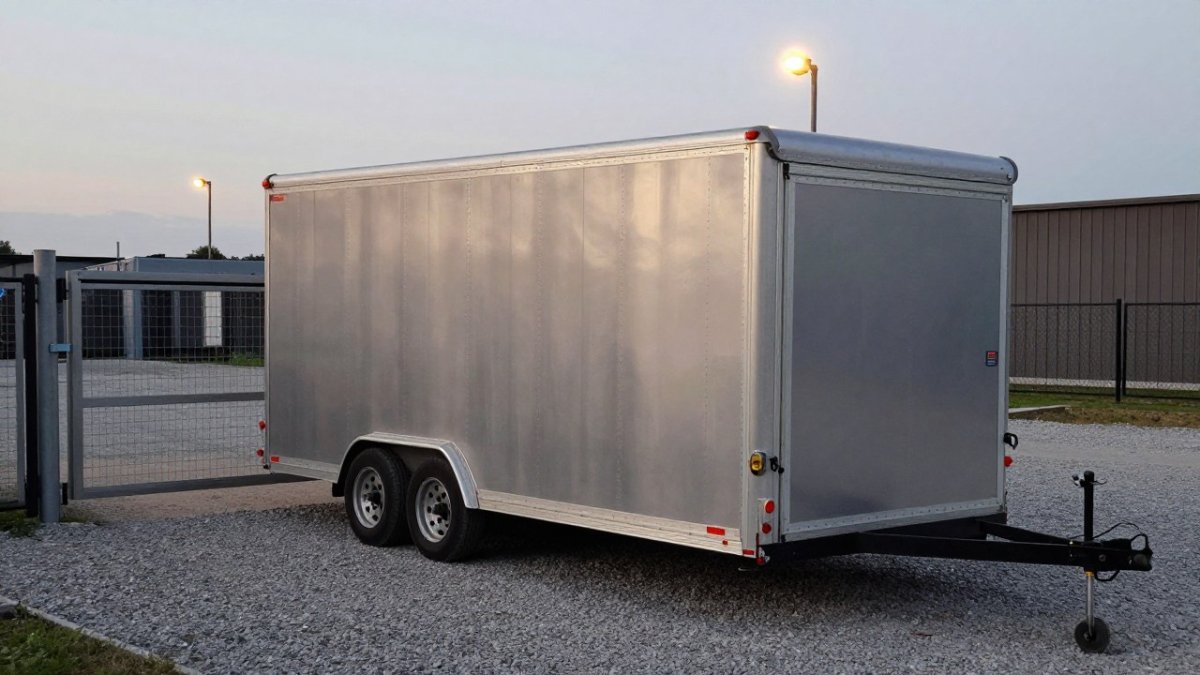
Outdoor trailer storage is a fenced or open lot where the trailer parks on a designated pad, exposed to the elements but secured behind a gate.
The tradeoff is real: sun, rain, and snow sit directly on the roof and seams. A trailer stored outdoors benefits from regular roof and seam checks.
If you are weighing a fenced yard against an open lot, our breakdown of outdoor RV storage parking requirements covers surfacing, setbacks, and access rules. Contractors who want the full picture on what a fenced rental involves can read what renting a fenced yard entails before committing.
Indoor RV Storage: When the Extra Protection Pays Off
Indoor RV storage puts the trailer inside a building, which removes UV exposure, hail risk, and most pest pressure. It costs more per month, and access is usually scheduled rather than drive-up.
The extra protection pays off in three cases: a trailer with a high replacement value, a trailer stored more than six months a year, or a trailer with finishes that degrade in sunlight. For a work trailer that leaves the yard weekly, indoor storage is usually money spent on protection you never use.
Large Trailer Storage Cost: What Drives the Monthly Bill
Large trailer storage cost depends on four variables: length of the spot, whether there is a roof, the security level of the facility, and the local market. Published industry estimates put enclosed storage in a broad range, with one trailer storage guide from MyGoodMovers citing roughly $300 to $500 per month for enclosed space. Outdoor spots price well below that, and covered pads sit in between.
Call and ask for a spot-specific quote.
The Full Cost Stack, Not Just the Monthly Rate
The advertised monthly rate is only one line on the bill. Ask for these five numbers before you compare facilities:
- Monthly rent. The base rate for the spot size and protection level.
- Security deposit. Commonly one month's rent, sometimes refundable only after a move-out inspection.
- Administration or setup fee. A one-time charge at signing, often $25 to $75.
- Access fees. Some indoor facilities charge for gate access outside business hours or for each entry after a set number per month.
- Insurance. Facility liability coverage usually protects the building, not your trailer. Confirm whether your tow-vehicle or homeowner policy covers a stored trailer, and whether the facility requires proof of coverage.
Add these to get a first-year total, then divide by 12 for a true monthly cost. A $250 outdoor spot with a $250 deposit and a $50 setup fee costs about $275 per month in year one; a $400 indoor spot with the same deposit and fee costs about $425.
Comparing Storage Types by Total Cost
Use this framework to compare options on the same basis. The figures below are typical patterns, not quotes; confirm each line with the facility.
| Cost Line | Outdoor Yard | Covered Pad | Indoor Unit |
|---|---|---|---|
| Monthly rent | Lowest | Middle | Highest |
| Deposit | Often one month | Often one month | Often one month |
| Setup fee | Common | Common | Common |
| Access fees | Rare | Sometimes | More common |
| Insurance gap | Owner's policy | Owner's policy | Owner's policy |
| Weather repair risk | Highest | Moderate | Lowest |
The cheapest monthly rate is not always the lowest total cost. A trailer stored outdoors may need roof resealing, tire replacement, and cover replacement more often, and those repairs can erase the savings over a few seasons.
Cost by Duration
Short-term storage favors outdoor yards because there is no long-term commitment and access is drive-up. Seasonal storage of four to six months favors covered pads, which cut UV and hail exposure at a middle price. Year-round storage of a high-value trailer favors indoor units, where the protection cost is spread across 12 months and the trailer holds its condition.
For a step-by-step walkthrough of the reservation process, see our guide on booking secure outdoor storage space.
Long-Term RV Storage: Preparing Your Trailer to Sit
Long-term RV storage is parking a trailer for a season or more, and it needs preparation that short-term storage does not. A trailer that sits unprepared develops flat spots, seized brakes, and moisture damage.
Do these before the trailer goes idle:
- Wash and dry the exterior, then inspect roof seams
- Inflate tires to the upper recommended pressure and block the axles
- Disconnect the battery and store it on a tender
- Drain fresh water tanks and lines
- Leave vents cracked for airflow, covered with vent screens
- Lock the coupler and remove the hitch
Check on the trailer monthly if the facility allows it. A quick walk-around catches a loose cover or a wasp nest before it becomes a repair bill.
Security, Access, and Facility Rules to Check
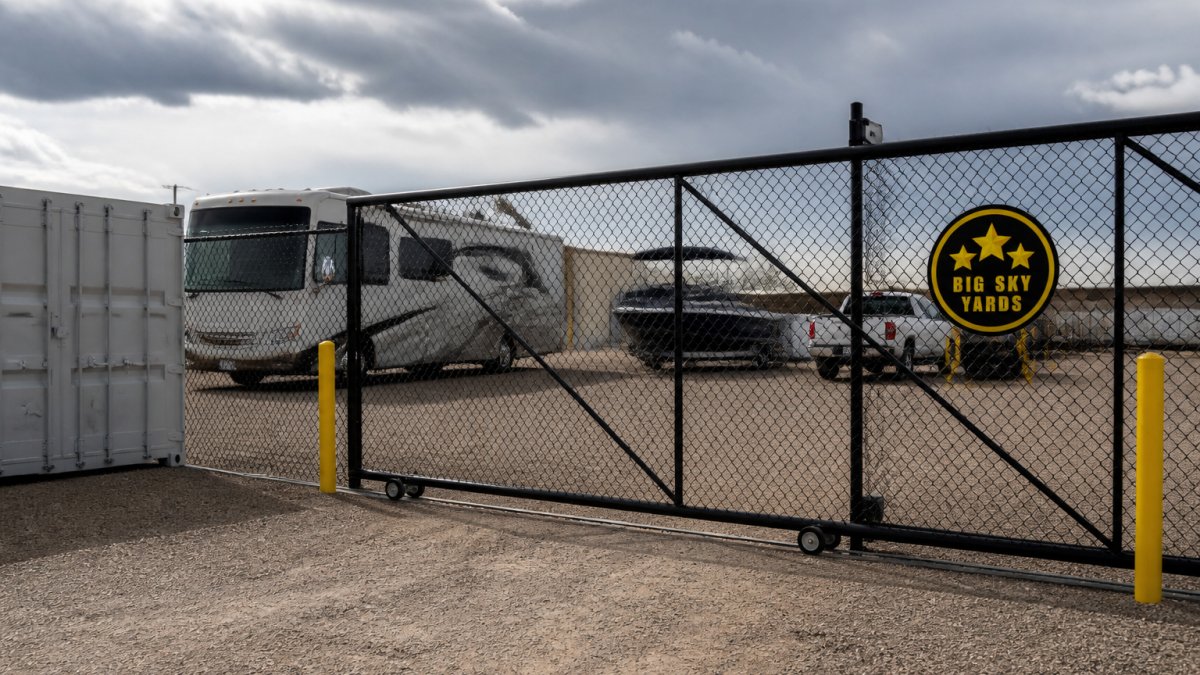
Security is the first thing contractors ask us about, and it should be. Ask every facility about gate locking, camera monitoring, onsite lighting, and key access. A gated yard with locking gates, onsite lights, and cameras is the baseline. Beyond that, ask about access hours and what the notice period is to cancel. If you want to understand why gated yards reduce theft risk, our article on the benefits of gated storage yards explains the access controls that matter.
Reserving a Yard Space for Your Trailer
Reserving a space is faster if you have your measurements ready. Confirm the spot dimensions against your trailer, and read the terms on cancellation before you sign.
Bring your trailer's registration and a photo of the trailer to the walkthrough. Confirm the spot fits before you sign, not after. For a step-by-step walkthrough of the reservation process, see our guide on booking secure outdoor storage space.
Choosing storage for a large trailer is a fit problem, not a price problem. Get the measurements right, match the protection level to how often the trailer moves, and confirm the security terms in writing.
Frequently Asked Questions
What size storage space do I need for a large trailer?
Measure your trailer's total length from coupler to rear, plus its width and height including any roof vents or racks. For a large trailer, a 12x40 parking spot is a common fit. Add a few feet of clearance for the tow vehicle and for opening the ramp or doors. Bring your measurements to the facility so staff can confirm the space works before you sign.
Is indoor or outdoor storage better for a large trailer?
Outdoor trailer storage in a fenced, camera-monitored yard costs less and gives you drive-up access, which suits working trailers that move often. Match the choice to how often you tow and what the trailer is worth.
How much does it cost to store a 40ft trailer?
Pricing depends on quantity, dates, and delivery. For current prices or a quote, see the Big Sky Self Storage Yards pricing page.
How can I protect a trailer during long-term storage?
Wash and dry the trailer, then check seals and roof seams before parking it. Remove food and anything that attracts pests, disconnect the battery or put it on a maintainer, and block the wheels instead of relying on the parking brake. Visit monthly to check tires and locks where the facility allows it.
What is the most affordable way to store a trailer?
Ask about annual rates and any cancellation terms before you commit.